
Adding doors used to be how to tell if your property management company’s growth is real. Now, with operating costs averaging $8,657 per unit as of 2024, new doors no longer automatically increase NOI. The firms pulling ahead in 2026 track two numbers: doors added and doors kept. The second one is the one that determines whether growth is real. This guide walks you through what moves that second number.
Key takeaways
- Track owner retention quarterly as a net doors metric
- Before entering a new submarket, audit local supply conditions
- Lead with compliance and apply your written criteria to every prospect, including referrals from sources you trust
- Pick a platform with a built-in upgrade path: Yardi Breeze, Yardi Breeze Premier and Yardi Voyager share the same database structure, and moving between them preserves accounting history, resident records and approval workflows without a data migration restart
Owner churn helps measure growth
Owner churn is a problem most companies don’t know they have. They track gross door additions and call it growth.
Acquiring a new owner costs more in time and effort than keeping one. A firm adding doors while losing accounts is replacing revenue at a loss. Track net doors instead.
When an owner leaves, they rarely take one door. Many small operators manage four, six or sometimes twelve properties under a single relationship, which means one lost account can reshape a portfolio overnight. And because owners talk to other owners, the reputational effect compounds faster than any marketing effort can correct it.
Measure your rate of owner churn
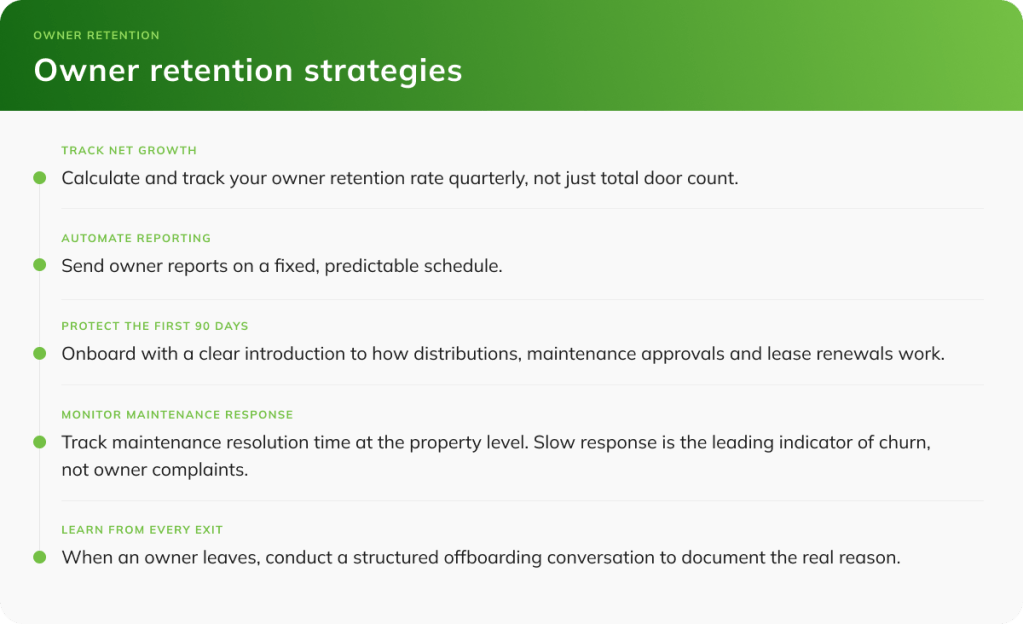
- Work out your owner retention rate. Divide the owners still with you at year’s end by the owners you started the year with and track that number next to your gross door additions.
- Identify what drives owners to leave. Slow maintenance is usually near the top. When repairs drag, owners start wondering what shape their property is really in.
- Audit your owner reporting. An owner who can’t get current numbers on their own property feels out of the loop, and that’s when they start looking around.
Add doors to a portfolio where reporting, maintenance or communication is already shaky, and you’re just adding future churn.
Know which markets are working before you commit to them
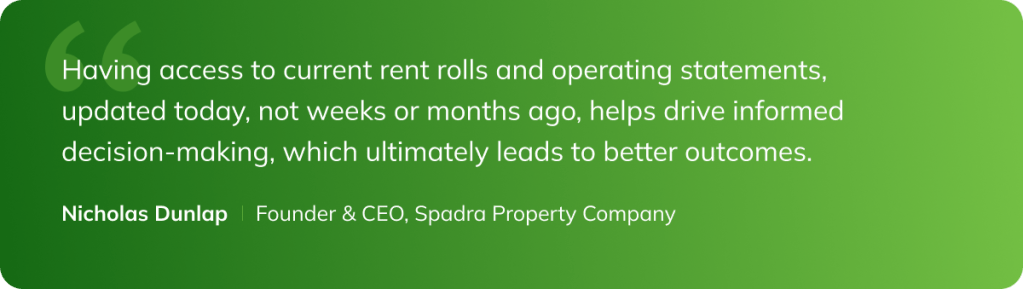
Most growth advice focuses on operations, on whether your systems can handle more doors. That matters, but very few ask whether the market they’re expanding into is worth expanding into right now.
An owner whose market has gone flat will likely have little patience for fees and disputes. An owner in a tightening market watches the numbers prove the fee for you. Expanding into the first kind of market raises churn risk before you’ve added a single door.
Build your vendor network before you need it
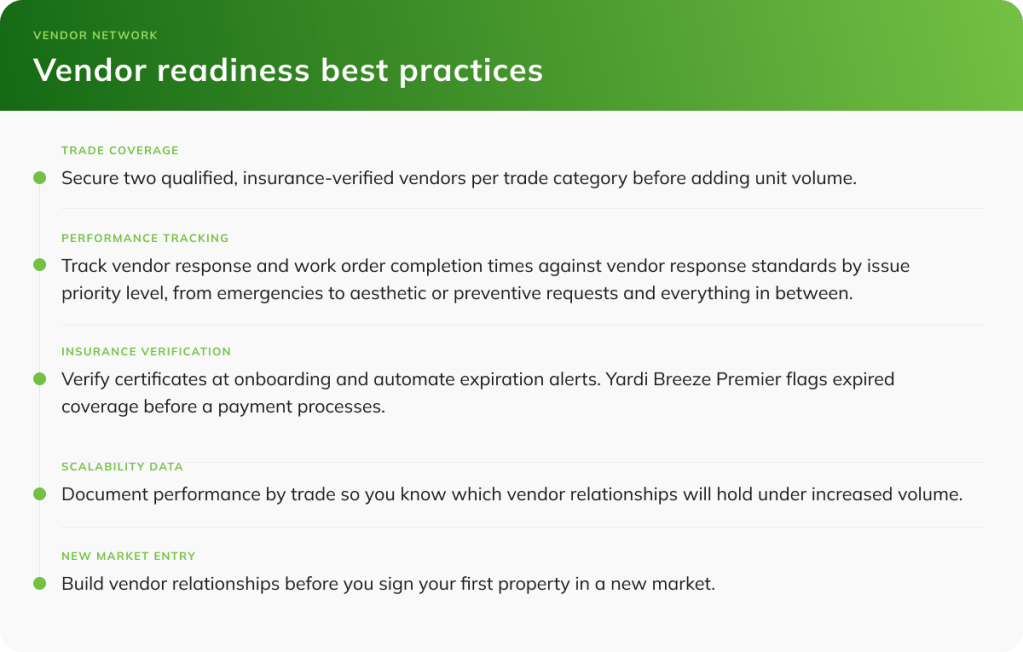
When you add doors, the constraint that shows up first has to do with whether your HVAC contractors, plumbers, electricians and maintenance techs can absorb the additional volume without their response times slipping.
A good HVAC contractor in your market is juggling several other property management relationships. Before you commit to a new submarket or a significant door increase in your current one, run a simple capacity audit against this threshold. A workable rule of thumb is to have two qualified, available vendors per trade category for every 100 doors you manage: one primary and one backup. If either slot is empty heading into a growth push, fill it before you close the new business.
Backups matter because contractors don’t disappear, but they get overextended across their client base. When your primary HVAC vendor hits capacity in July, your backup is the difference between a 24-hour response and a four-day wait. At 200 units, with four trade categories and no backup coverage, you have four single points of failure running simultaneously.
Slower maintenance turns into owner confidence problems. It surfaces on reports weeks after the damage is done.
The accidental landlord is a fast-growing pipeline
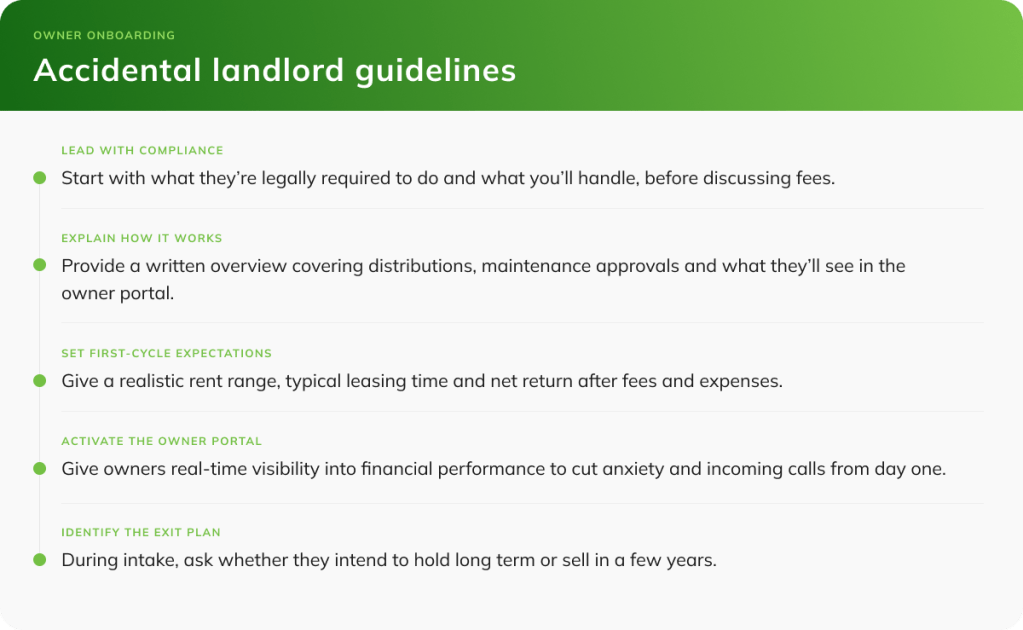
A sustained mismatch between home prices, mortgage rates and buyer demand has pushed a growing number of homeowners into renting out their homes. These are individuals who couldn’t sell their homes at acceptable prices and converted their properties to rentals instead. They arrived in the market without systems, experience or any appetite for the learning curve. This is precisely when a professional property management company offers its clearest value proposition.
Compliance is where you can stand out with these owners. A homeowner who becomes a landlord inherits a set of legal obligations they’ve likely never dealt with, from security deposit laws to eviction procedures. A property manager who leads with that expertise can turn a reluctant owner into a long-term client.
Selective growth protects your portfolio’s performance
Say a difficult owner relationship costs your team three hours per week in communications, disputes and re-explanations at an effective rate of $35 per hour. That’s $5,460 per year no fee report will ever show.
Questions to ask before taking on any new property:
- Are the owner’s expectations of rent, vacancy and maintenance costs consistent with the current market?
- Is the property in a condition your vendors can maintain without emergency escalation in the first 90 days?
- Does this property type fit the workflows and vendor relationships you already have?
- What will this property earn you once you factor in the hours it takes to run it, not just the management fee?
Write down your intake criteria, making sure to cover property type, unit size range, location, minimum condition standards and owner communication expectations. Selectivity protects the capacity that drives future revenue. Apply the criteria consistently, including when the referral comes from a source you trust.
Keeping good tenants does more for your margins than finding new ones
Every turnover costs money: vacancy loss, cleaning and repairs, leasing time, advertising spend, etc. Keeping a good tenant for another term is often worth more to your bottom line than signing a new property.
Lease renewals now account for 57% of all leasing activity nationally, according to CBRE. In that environment, retention is the primary revenue strategy.
How to run a proactive renewal process:
- Start your renewal process 90 days out
- Contact tenants directly, asking if anything needs attention before renewal
- Online lease signing and resident payment portals in Yardi Breeze reduce the friction of committing to another term
- Track renewal rate by property, not just portfolio-wide
Clean lease terminations protect your owner relationships
How you manage tenant exits directly affects owner trust and the referrals your business depends on. A lease termination agreement generally includes a mutual release of claims from both parties. That last element is frequently skipped and frequently regretted.
Early lease terminations require particular care. Build an early termination clause into every lease at signing so the framework exists before a departure becomes a negotiation under pressure. State notice requirements vary widely, from as few as seven days to as many as 60, depending on jurisdiction. Verify the requirements for each property’s location before acting.
Your team handles more doors when AI handles the repetitive work
In a tight market, the surest way to improve margins is to get more out of your portfolio without adding payroll. AI is how property managers get there fast, spending less time on routine work and more time on the decisions that grow the business.
The tasks worth automating first are the ones your team does the same every time: rent reminders, maintenance request routing, invoice data entry and owner report generation. All these tasks consume hours that could go to owner relationships, leasing decisions and problem-solving. The key is to protect the time that requires a person.
Invoice processing is where the time savings are most immediate. Yardi Smart AP is a free AI invoice processing tool built into Yardi Breeze Premier and can be activated within a few business days.
It reads invoices, extracts key data and creates an invoice record automatically. No manual entry required. Vendors send invoices the same way they always have. Smart AP handles the intake, and your existing approval workflow stays intact.
Property management software that scales with you means you only switch once
Switching platforms mid-growth means data migration, staff retraining and a gap period where historical and current reporting live in different systems. All of it costs time and owner confidence.
The firms that manage it well treat the transition as a project with a dedicated owner, a parallel-run period and direct communication to owners about what’s changing and why.
Choose carefully before you scale, because switching costs grow with the portfolio. Read how Robert Chiang helps real estate investors and owners see the value of property management software. He literally wrote a book on it.
Starting on a platform with a built-in upgrade path removes much of that risk. Yardi Breeze, Yardi Breeze Premier and Yardi Voyager share the same database structure, which means moving between them doesn’t require starting over.
A company that grows from Breeze into Breeze Premier keeps its data, accounting history and resident records intact, with no re-registration required for the RentCafe portal and existing approval workflows carrying forward. When a portfolio reaches the scale where Voyager’s enterprise capabilities become necessary, the move builds on the same foundation rather than replacing it.
If you’re simply looking to start optimizing the portfolio operations you have today, see how Yardi Breeze can help you.
Frequently asked questions
What is the fastest way to grow a property management company?
Systematize your existing operations before adding units and measure net door growth instead of gross acquisitions, so you know whether your retention rate is undermining your expansion. The fastest sustainable growth comes from referrals from satisfied owners, specializing in a specific property type and using technology to expand capacity without proportional hiring.
What should a lease termination agreement include?
A lease termination agreement needs both parties’ full names, the property address, the original lease date, the agreed termination date, financial terms including deposit return, move-out conditions, a mutual release of claims from both parties and signatures with dates. State laws vary, so have your attorney review any template before using it across your portfolio.
How many units do you need to have a profitable property management company?
Profitability depends more on operational efficiency and owner retention than unit count. Property management businesses managing fewer than 100 units frequently struggle with economies of scale. With the right software and defined workflows, firms in the under 500-unit range can run efficiently and profitably, but only if the quality of the portfolio matters as much as the size.
How do you find new property management clients in a slow market?
Referrals from existing owners remain the highest quality lead source regardless of market conditions. The accidental landlord segment is a growing channel most competitors aren’t serving with dedicated onboarding or compliance education. Regulatory expertise, communicated clearly in your marketing, attracts owners who can’t self-manage safely in an increasingly complex legal environment.
What are the biggest obstacles to growing a property management company?
Owner churn is the most underdiagnosed obstacle: net door growth that looks positive while masking the cost of replacement. After that, the next constraint is vendor capacity, which caps how fast you can absorb new units without service slipping. The other two are low tenant retention, which quietly erodes occupancy, and owner expectations out of step with the market.
When should a property manager consider geographic expansion?
Expand only after you have a replicable operational model: documented workflows, software that scales across locations and at least two people who can run a market without you. The most common mistake is entering a second market while the first one still depends on the founder for day-to-day decisions.
Adding doors, owner relationships and vendor depth in your current market usually pays better than opening a second one.
Disclaimer
This article is for informational purposes only and does not constitute legal advice. Laws governing lease termination vary by state and locality. Consult your attorney before drafting or finalizing any termination agreement.