
Move-in dates land wherever life puts them, and plenty fall mid-month. Prorated rent is the partial month renters owe when a lease starts or ends on any other day than the first of the month. It’s calculated by dividing monthly rent by a set number of days, then multiplying by the days the unit is occupied. Configured once at the property level, it produces the same first-month charge for every lease, so the number never depends on who processed the move-in.
Two formulas for calculating prorated rent
Every proration calculation comes down to one question: What do you divide by? The 30-day method treats every month as 30 days. The actual days method uses the real length of the month in question, anywhere from 28 to 31.
For illustration, using $1,000 monthly rent and a resident occupying 12 days:
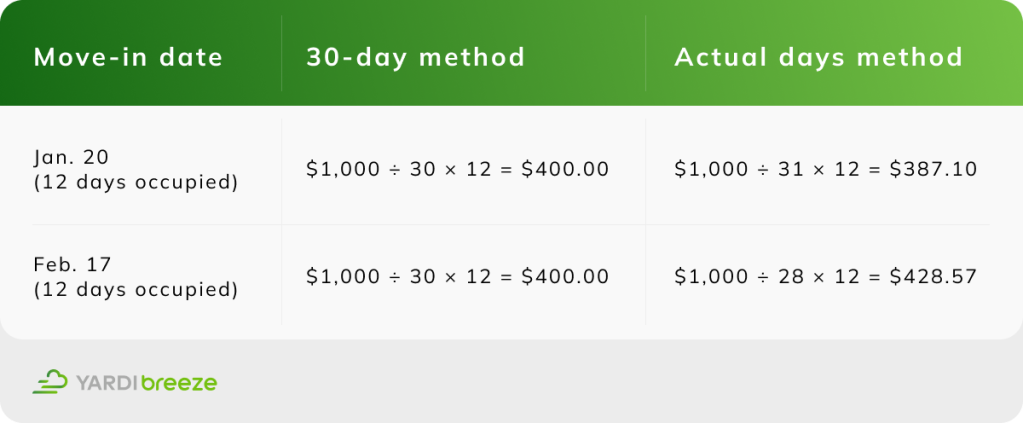
Assumes the move-in day is charged. Excluding it shifts each figure down by one day of rent.
The 30-day method looks simpler, and it behaves differently too: a little more collected in 31-day months, a little less in February. What it never does is overcharge for a full month. Proration only applies to partial months, so a resident who occupies all 31 days of January owes the contract rent of $1,000, not a daily rate multiplied by 31. Which method you use only matters between move-in and the first full billing period, and again at move-out.
Whether the swings matter depends on when your move-ins land. A fixed-day approach can benefit you when move-ins fall in 31-day months. Either way, it is a number your residents can calculate for themselves.
The four settings behind every prorated charge
Charging a full month regardless of move-in date is an option depending on your property location, and it is generally permitted in most jurisdictions. Every other configuration decision follows from that first answer:
- Whether to prorate at all. A full-month charge is easier to bill but harder to defend when nearby properties prorate.
- Whether the move-in day is billable. Charging it is standard, though excluding it costs only one day of rent and gives your leasing team a concession to offer.
- Whether the move-out day is billable. Keep this separate from the move-in setting. Treat them as one and you’ll bill the outgoing resident’s last day and the incoming resident’s first day at the same time.
- Whether you divide by 30 days or by the actual days method.
Left to individual judgment, those four settings produce variations that can surface later in a dispute.
Consistency is the real compliance concern
Prorated rent rarely triggers a legal problem, though inconsistent proration is a different matter. Say one resident’s first month was figured for 30 days and a neighbor’s for 31. If those two residents differ in a protected characteristic, the difference will be difficult to justify legally. Fair housing claims rest on patterns of unequal treatment, and a rent charge is the last place you want unexplained differences showing up.
State the method in your lease, configure it at the property level and avoid manual overrides on individual leases without a written reason. Some state and local rules address proration in specific regulated contexts. Check your jurisdiction before finalizing a policy and put the method in the lease either way, so the number is never a surprise at signing.
How proration works in Yardi Breeze
Yardi Breeze and Yardi Breeze Premier handle proration as a property default rather than a per-lease entry, so the settings you choose apply to every move-in and move-out on that property.
At move-in, the prorated amount appears as the resident is added, so your leasing agent can quote the exact first-month figure during signing rather than promising to follow up.
A fifth setting handles the late-month signing. Charge Next Month if Move-In After Day X lets you collect the prorated amount for the first month and the following full month together at move-in. The resident writes a single check instead of two within the same week, and you avoid a collections conversation in the opening days of the tenancy.
Move-out proration needs its own answer
The money at move-out can travel in either direction. That means a resident who already paid the full month is owed a credit and one who has not is owed a charge.
Decide in advance which of those your workflow handles automatically and which requires a manual entry against the deposit refund. Then confirm it in your own configuration rather than assuming. Run one test move-out before you rely on the answer at scale.
Whether you prorate move-outs at all is a separate question. Many operators prorate move-ins and charge the full final month, reasoning that a unit vacated mid-month can’t realistically be re-leased the next day. That is a legitimate position, so put it in the lease.
Setting your proration policy in five steps
- Pull your last 12 months of move-ins and check whether the first-month charges were calculated the same way. Variance there tells you how much cleanup a policy change will involve.
- Choose one calculation method per property type. Mixed portfolios can justify different methods for residential and commercial, but not for two identical residential properties across town.
- Write the method into the lease template in plain language, including a worked example with real numbers.
- Configure the settings at the property level so no one is calculating by hand.
- Test one move-in and one move-out against your own math before the next leasing season and confirm the move-out path specifically.
Frequently asked questions
Divide the monthly rent by either 30 or the actual number of days in the month, then multiply by the number of days the resident occupies the unit. A $1,000 rent with a 12-day occupancy in a 31-day month comes to $400.00 using the 30-day method and $387.10 using actual days. Both are correct as long as your lease specifies which one applies.
Daily proration is the standard for residential leases because it matches how long the resident occupied the space. Monthly proration, meaning a full month charged regardless of move-in date, is simpler to administer but harder to sustain in a competitive market. Commercial leases more often specify their own formula in the lease document, which supersedes any default.
Most operators charge it, on the reasoning that the resident has possession and access from that morning. Excluding it costs one day of rent per move-in and gives your leasing team a small concession to offer. What matters is applying the same rule to every lease on the property.
If the resident has already paid the full month, they are owed a credit for the unoccupied days. If they have not, they owe a prorated charge for the days they stayed. Whether you prorate move-outs at all is a policy choice and it belongs in the lease rather than in a move-out conversation.
In most jurisdictions there is no general legal requirement to prorate. Some states and municipalities address it in specific regulated contexts, so check local law. In practice, declining to prorate a move-in is a competitive disadvantage in almost every market.
Get the policy set before the next leasing season
Proration is a small number that generates a disproportionate share of first-month friction, and almost all of it traces back to inconsistency. Pick a method and write it into the lease, then configure it at the property level so nobody recalculates it lease by lease.
For more on automating recurring charges, see how common area maintenance reconciliation works in Yardi Breeze and how RentCafe Flexible Rent helps residents align payments with pay days.
Disclaimer
This article is for informational purposes only and does not constitute legal advice. Laws governing rent proration and lease terms vary by state and locality. Consult your attorney before setting up or changing a proration policy.